The theme of trusting only yourself
Three SecondsThe theme of trusting only yourself shapes Piet Hoffmann’s survival strategy as he moves from a secret government meeting toward infiltration and confinement at Aspsås Prison. It begins as a hard-earned rule for a man caught between Wojtek and the authorities: both can offer assurances, but neither can make him safe from betrayal. The rule gives him a way to act when protection is uncertain, yet it also describes the loneliness and divided identity his undercover life has produced.
A Rule Formed Between Two Sides
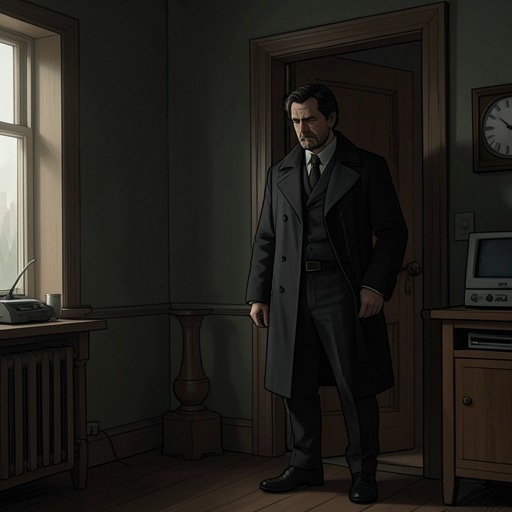
At the government meeting, the participants stand and the discussion appears to be over, but Hoffmann does not leave with the assurances he needs. He longs to return to Zofia, yet first asks that the guarantee be stated so clearly that it cannot be interpreted in more than one way. The distinction matters: a promise is not protection unless its terms can be made definite. When he asks how the guarantee will work, he is told that they have already discussed it three times. Repetition has not made the answer convincing.
The authorities’ promises recall those of Wojtek. Hoffmann recognizes that the two sides use the same language and seem to offer the same route out, although they stand on opposite sides of the law. Neither assurance is enough. His demand for clarity is therefore more than caution about wording; it reflects the absence of a dependable power to whom he can entrust his safety.
Erik Wilson gives the danger its starkest form. He tells Hoffmann that he is now an outlaw, vulnerable to Wojtek if his infiltration is exposed and to officials who may sacrifice him because he knows what those present will not admit. Hoffmann is at once Wojtek’s principal man and the authorities’ principal man, but Wilson warns that an emergency will leave him on his own. The warning makes self-reliance less a freely chosen ideal than the condition imposed by a double allegiance: each side may value Hoffmann while he is useful and abandon him when he becomes a threat.
Preparation in Isolation
At Aspsås Church, Hoffmann prepares without visible assistance. He attaches a thin black cable and two small transmitters to the outside of the balcony railing, splices the cable, and connects it to a small black component; a solar cell is also part of the arrangement. The equipment is positioned to be invisible to someone standing on the balcony. Its purpose is to let someone serving time inside Aspsås Prison hear the words spoken there. The installation turns a solitary act of preparation into a means of obtaining knowledge from within the prison walls.
The scene binds the theme to method. Hoffmann checks that the equipment is attached properly, then studies the view and rehearses an imagined firing position toward a second-floor window in Block B. He observes the trees by the churchyard wall while considering what would happen if he were exposed, abandoned, or left without anyone to rely on. In that eventuality, he believes, there would be no remaining choice and he would die. The imagined weapon is not an act of violence in the scene; it is part of his private assessment of a danger for which he expects no reliable rescue.
When he sees Aspsås Church through morning mist, he knows that his next view of it will be from a cell window. His preparations are complete, and he anticipates being entirely alone. The thought of Zofia makes that separation personal, while his reflection on years of lying to her, Hugo, Rasmus, and others shows how the rule has spread beyond operational secrecy. Each new reality requires another lie. He can no longer locate a secure boundary between truth and falsehood, or be entirely sure who he is. Self-reliance may help him survive an assignment, but it cannot restore the trust his prolonged concealment has eroded.
Entering the Prison System
Hoffmann’s first passage through Aspsås Prison’s gates brings the carefully studied institution into direct contact with his body and daily life. He has mapped its buildings from the church tower and learned about the people and corridors of Block G while on remand, but this is his first time inside one of the country’s highest-security prisons. Leg irons shorten his steps; guards escort him through a separate entrance into registration, where his restraints are removed for a search. He is issued loose, unattractive clothes and taken to a sterile waiting room. Knowledge gathered from outside has prepared him, but it has not spared him the procedures of admission or made him part of the place.
After ten days, his circumstances have narrowed to a five-square-metre cell. For twenty-three hours a day he lies behind a metal door with a corridor peephole; he has no visitors, newspapers, television, or radio. The routine makes time itself part of confinement. His earlier preparations depended on observation and initiative; here, isolation is administered through restricted space, contact, and information. He has become used to having someone nearby and discovers how strongly loneliness intensifies his longing.
The contrast between planning alone and being made alone is central to the theme. In the first case, keeping watch and relying on his own judgment are tactics. In the cell, solitude is imposed by the prison and restricts the resources on which those tactics depend. Self-trust remains necessary, but it cannot be mistaken for freedom from other people or institutions.
Performing Self-Reliance Among Prisoners
When Hoffmann is introduced to the unit, he accepts the principal officer’s guidance about its routines, including where to use the toilet and why lock-in occurs at seven thirty. He knows that the unit will be empty for another three hours while the other prisoners are at work, the library, or the classroom. That interval gives him time to learn the layout and to face the prospect that his cell is now his home.
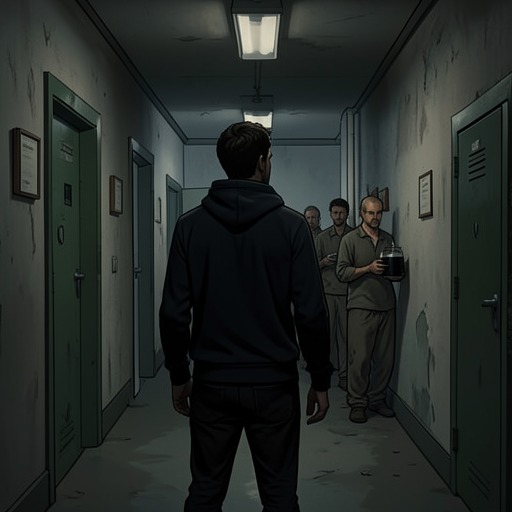
Before the others return, he sits in the television corner where everyone entering will see him. He has studied photographs and backgrounds of the unit’s fifteen prisoners, but his placement is also a deliberate public introduction. He occupies another person’s favored chair, takes marked cards, and begins playing solitaire at a table without asking permission. Rather than hide and wait to seek approval, he makes himself conspicuous and acts as though he belongs. The conduct presents composure as a form of self-protection: he wants to be seen as someone who is not afraid to appear in the shared space. His attention is fixed on two particular faces, so the display also serves a specific purpose, although their identities are not established here.
The same institution later offers a different kind of separation. When Hoffmann faces exposure, he cannot escape far within a prison, but he can ask to be placed in isolation. Ten members of the prison riot squad arrive in helmets and shields, carrying sedatives. Six remain to discourage further violence while four escort him through Block G and down to the voluntary isolation unit in Block C. There, the sixteen-cell unit resembles an ordinary prison unit in its wardens’ room, television corner, showers, kitchen, and Ping-Pong table, but its residents can move around without encountering prisoners from other units. The arrangement limits contact while preserving movement inside the unit: even isolation has rules and an institutional shape.
Meaning and Limits
Across these episodes, self-trust has several related meanings. It is Hoffmann’s response to guarantees that cannot neutralize the risk of abandonment; it is the discipline behind his hidden listening apparatus and advance study of the prison; and, inside the unit, it becomes a performance of confidence designed to establish his presence. Each use belongs to a different setting, but all answer the same uncertainty about who can be relied upon.
The theme does not present solitary independence as a complete solution. Hoffmann’s preparation gives him information, and his controlled entrance into the unit lets him act rather than wait passively. Yet the warning that both sides may discard him remains, while years of deception have blurred his own sense of identity and estranged him from his family. The prison can also enforce solitude more completely than he can choose it. Trusting only himself is therefore both a survival rule and evidence of the costs of survival: it helps him move through danger, but it offers no guarantee of safety, belonging, or a stable self.